Perhaps I should discuss my history of cookbook collecting before jumping into the next recipe of “A Completely Random Cooking Challenge”. It began in college, with the books The Smitten Kitchen Cookbook and Plenty, two classics that I still use regularly. I was pescatarian and learning how to cook. At the time, the “Leek Fritters with Garlic and Lemon” from Smitten Kitchen and “Sweet Potato Cakes” from Plenty were the best things I ever made. Like most college students, I thought I was, simply, amazing.
Fast forward to graduate school, living in my very own apartment and no longer a pescatarian (I started eating chicken, just the breast). I bought more chef-y and restaurant cookbooks, Heritage by Sean Brock, The Bouchon Bakery Cookbook, My Portugal by George Mendes, and The Slanted Door by Charles Phan. I also bought my second Ottolenghi book, Jerusalem. I spent Sundays cooking and baking in my tiny kitchen on my two foot-long counter. Oh the joy of Monday packed lunches – “Squash-Seed Risotto”, “Vietnamese Chicken Salad”, and “Chocolate Chunk and Chip Cookies”.
Another decade went by. I started dating someone who became my husband. He likes chicken thighs, so I started cooking and eating those, too (oh, was I missing out!). We moved into an apartment and later a house. He is gluten- and lactose-free. We had three children, each with their own precious palate. I kept buying cookbooks; too many to list here. I have not counted, but I estimate my collection stands in the 150-200 book range.
That’s a lot of life (and shopping) to cram into a few sentences, but the takeaway is that my cooking has had to evolve. No more squash seed risottos, which are delicious, by the way. I need food my family will eat, that I can make while holding a baby and prying two sisters off one another. My most recent purchase, quite aptly, was What To Cook When You Don’t Feel Like Cooking.
So, while most of the collection languishes in our primary bedroom closet for the time being, I have curated the in-kitchen shelf to be the books I actually use. These are the books I want to, and will, cook from these days. They are the cuisines (Middle Eastern, Asian) and sweets (cookies) I am craving. And I am working my way through them, completely randomly.
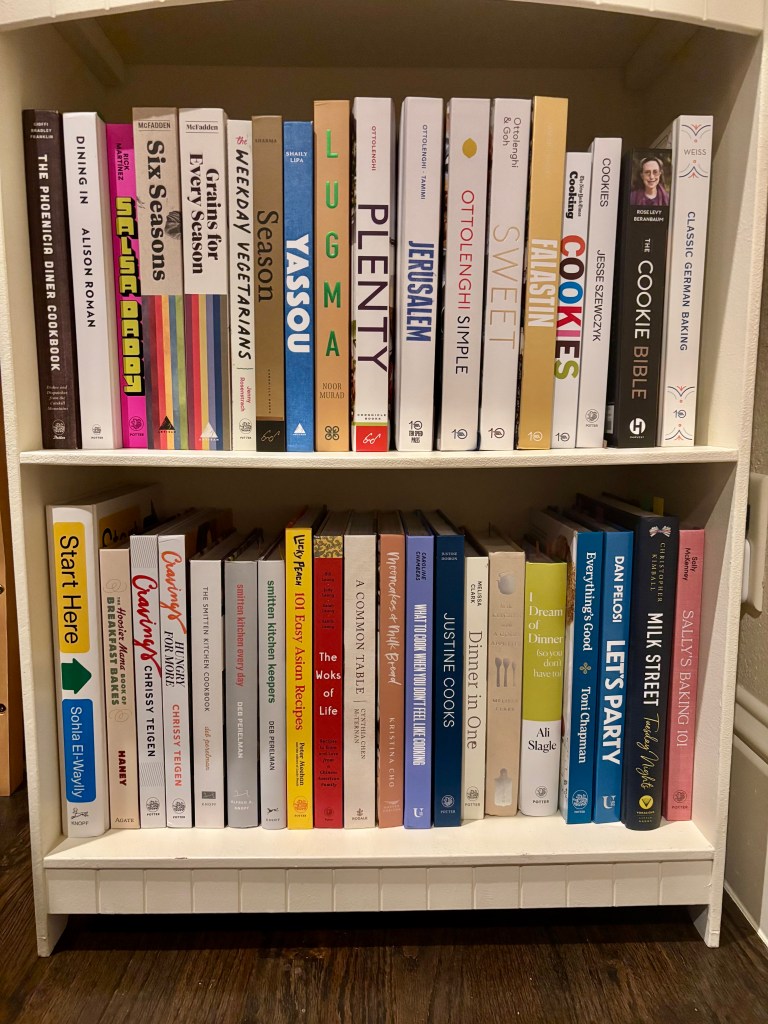
For “A Completely Random Cooking Challenge” this month, I assigned each cookbook on my shelf a number from 1-37. I use a random number generator to spit out a number. I take the corresponding cookbook off the shelf, count the number of recipes in that book, and use the random number generator again to assign me a recipe to cook from the book.
The rules are:
- I must stay as true to the recipe as possible.
- I can skip the recipe entirely if I have cooked it before, if it has a hyper-seasonal ingredient (for example, wild ramps or a whole pumpkin), or prominently features an ingredient my family does not eat (for example, duck confit).
- I can save the recipe for the weekend if it takes more than two consecutive hours of cooking time or has a hard-to-source ingredient (for instance, a six-hour oven braise that is finished with perilla oil).
I wrote about my first set of random numbers here. For my second set of random numbers, I got cookbook number … 28!
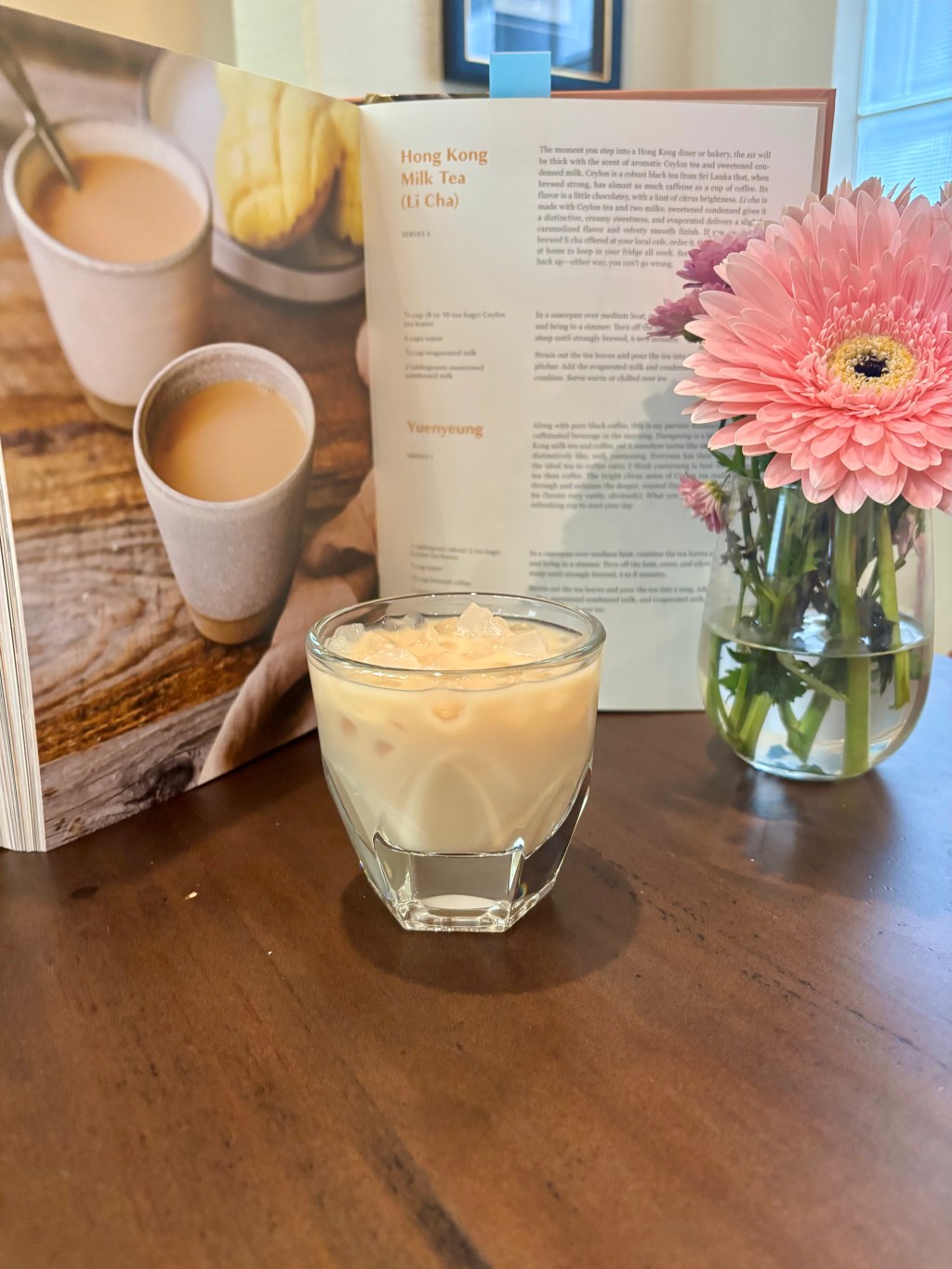
Book 28 is Mooncakes and Milk Bread. This cookbook has 81 recipes, the vast majority of which are Chinese baked goods, particularly buns (28 recipes), cakes and cookies (27 recipes), and shorter chapters on breads, breakfasts, and beverages. So, I was fully expecting a baking project. I entered 1 through 81 as the range in my random number generator and received the number 76. This lands squarely in the (gasp!) “Sips” (beverage) chapter. I am assigned to make “Hong Kong Milk Tea (Li Cha)”.
In full disclosure, I am not a tea drinker. I have a cappuccino every morning, and usually another and/or a shot of espresso every afternoon. Coffee is probably my desert island food. So, I was skeptical I would enjoy this recipe at all. But, the random nature of the universe calls, and I must make it.
I took my littlest two children to Whole Foods to buy Ceylon tea and sweetened condensed milk as listed in the ingredients. Sweetened condensed milk we found with no issue, but there was no Ceylon tea available. Rule #1 of this challenge states I must stay as true to the recipe as follows, so I did a quick Google search of appropriate substitutions while standing in the grocery store aisle. My kids sitting in the grocery cart were not amused – I saw the word “Kenyan” on my phone and on a box of tea on the shelf, with no time to read further. Eek, at checkout, I realized my panic and this tea cost $12.
Home again, kids are fine, let me try this very expensive beverage. First, I brewed the loose tea leaves in boiling water on the stove. I strained the tea through a fine mesh strainer, which turned out not to be fine enough. I had some particulates remaining in my strained solution, so I dug through our neglected under counter cabinet to find the perfect tool. Chinois? Holes are too big. Cheesecloth? Ah, perfect. I knew I bought you for a reason. The tea is looking clear now, so I stirred in the powdered milk and condensed milk. Unfortunately, because of my double straining issue, the tea was not so hot anymore. I decided to put it in the fridge and try it chilled later in the day, as the recipe introduction suggests as an option.
Come lunchtime, I fill a cappuccino glass with ice and pour the tea over it. The tea is fine, but it is not a cappuccino, and I do not enjoy it very much. I also suspect the ice is diluting the tea too much. I dump the ice and pour another glass, and I think it is better. I can tell that, despite no cappuccino, I did get caffeinated. Since I had a pitcher of tea leftover, I drank a glass or two everyday for the next four days. The tea really grew on me, and I particularly enjoyed it the day we got dumplings for a takeout lunch.
This is good, because I have $12 worth of tea left to drink.
 the cook stack
Leave a comment